
At the base layer (Layer 1) of every decentralized blockchain lies the Consensus Engine. Whether governed by Proof-of-Work (PoW) computational hashing or Proof-of-Stake (PoS) cryptographic bonding, consensus ensures that thousands of independent nodes agree on an identical, append-only transaction history without a central authority.
However, for individual miners or stakers, solo participation introduces severe payout variance: finding a block alone might take months or years. To solve this, the industry evolved Mining and Staking Aggregation Pools, allowing small contributors to combine capital and compute power to earn consistent, smoothed rewards.
System Architecture Diagram
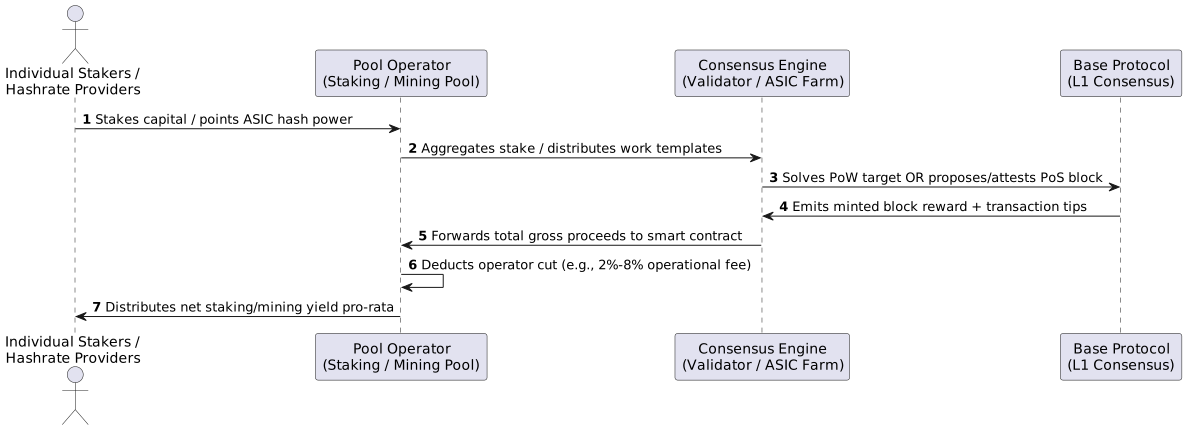
The sequence diagram below illustrates how individual hardware miners or stake delegators aggregate their contributions through pool operators to produce consensus-valid blocks on Layer 1 and receive proportional rewards:
Core Roles & Revenue Models
The consensus ecosystem balances physical infrastructure investments with cryptographic game theory:
Individual Stakers / Miners
Small-scale ASIC operators or individual token holders supplying computational hash shares or bonding native collateral.
Revenue: Proportional Payout SharesPool Operators
Coordinating infrastructure managing Stratum mining connections or validator node key managers, distributing work, and smoothing reward variance.
Revenue: 1%–10% Performance CommissionConsensus Engine
High-reliability physical validator nodes or ASIC clusters executing intensive hashing algorithms or generating BLS attestation signatures.
Function: Hardware & Cryptographic ExecutionBase Protocol (L1 Consensus)
The sovereign layer (Bitcoin, Ethereum L1) enforcing protocol rules, difficulty adjustments, finality checkpoints, and minting base currency.
Mechanism: Algorithmic Block SubsidiesSequence Flow Breakdown
The ten-step lifecycle detailed in Figure 4.1 outlines how decentralization and pooled efficiency coexist:
Contribution & Delegation
Individual hashrate providers point their ASIC hardware to the pool using protocols like Stratum v2, or stakers lock tokens into smart contract staking pools (e.g., Rocket Pool, Lido).
Aggregation & Job Dispatch
The Pool Operator aggregates the incoming hash shares or staked weight, constructs a standardized block template, and issues cryptographic computational assignments to the underlying consensus engines.
Cryptographic Verification & Share Submission
In PoW, ASICs compute SHA-256 hashes until finding nonces meeting target difficulty; in PoS, validators generate BLS aggregated attestation signatures confirming the current beacon slot.
Block Proposal
The validated block solution or attestation aggregate is broadcast across the L1 peer-to-peer network for protocol verification.
Protocol Verification & Subsidy Minting
L1 consensus rules verify that the block meets valid difficulty or quorum thresholds. The protocol finalizes the block and mints newly issued coins (block subsidy) alongside unspent transaction priority tips.
Management Commission Deduction
The pool operator automatically deducts a modest management fee (typically between 1% and 10%) to cover infrastructure hosting, node hardware, and DDoS mitigation costs.
Proportional Yield Payout
The net reward proceeds are distributed transparently and proportionally to all participating miners or delegators based on their proven shares or bonded stake.
Decentralization vs. Pooling Economics
Aggregation pools are an economic necessity: without them, variance would force small operators out of business, leaving only massive industrial data centers.
However, excessive concentration in a handful of pool operators introduces risks of censorship and governance capture. Modern innovations like Stratum V2 (which lets miners choose their own transaction templates) and Decentralized Staking Protocols (utilizing Distributed Validator Technology / DVT) are shifting template construction power back to the edges, ensuring Layer-1 networks remain resilient, neutral, and decentralized.