
Decentralized Finance (DeFi) replaces centralized intermediaries—such as brokerage clearinghouses, loan officers, and custodian banks—with deterministic smart contracts. However, smart contracts are cryptographically isolated state machines: they cannot natively fetch external market prices or trigger their own execution when loans become undercollateralized.
To maintain programmatic solvency and continuous liquidity, the DeFi ecosystem relies on a symbiotic relationship between Automated Market Makers (AMMs), Decentralized Oracle Networks (DONs), and autonomous Keeper and Liquidator bots.
System Architecture Diagram
The sequence diagram below visualizes how external real-world market volatility flows through price oracles into lending protocols, triggering automated liquidations and AMM arbitrage swaps:
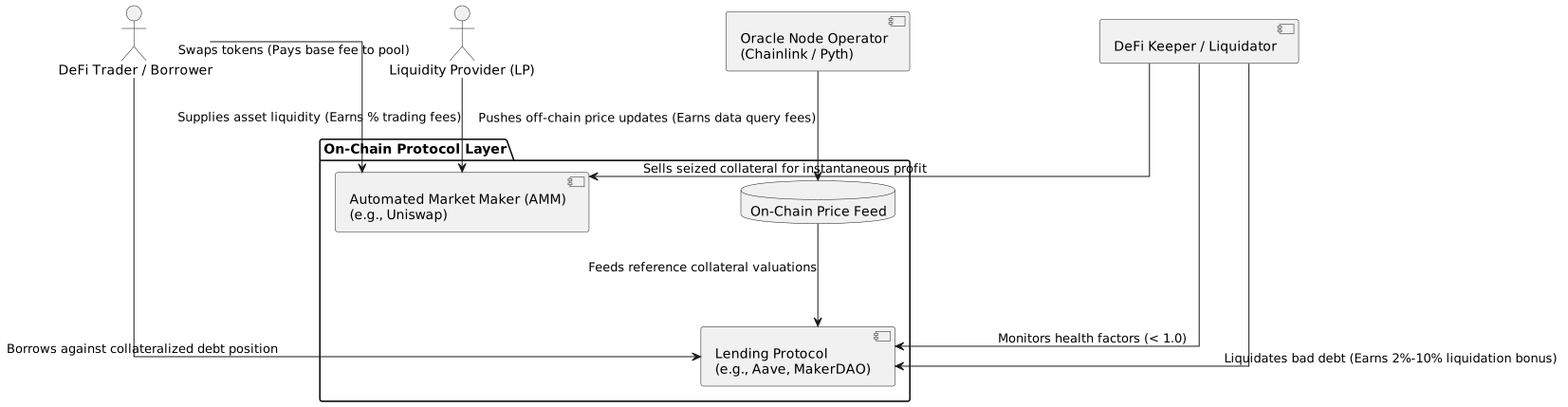
Core Market Actors & Commercial Models
In an open financial architecture, actors operate purely on economic incentives to keep pools funded and positions solvent:
Liquidity Providers (LPs)
Deposit matched pairs of assets into AMM liquidity pools (e.g., Uniswap v3/v4), enabling continuous trading without an order book.
Revenue: 0.05%–1.00% Cut of Trading VolumeOracle Node Operators
Decentralized nodes (e.g., Chainlink, Pyth) retrieving off-chain market prices from tier-1 exchanges, signing payloads, and publishing feeds on-chain.
Revenue: Data Query Fees + Token IncentivesLending Protocols
Autonomous money markets (e.g., Aave, MakerDAO) issuing loans against overcollateralized deposits governed by algorithmically adjusted interest rates.
Model: Interest Rate Spread & Reserve FactorDeFi Keepers & Liquidators
Independent arbitrage bots running 24/7 to monitor health factors across all borrowing positions and execute immediate debt liquidations.
Revenue: 2%–10% Liquidation Discount BonusStep-by-Step Operational Lifecycle
Following the sequential numbered events in Figure 3.1 demonstrates how financial equilibrium is preserved during market stress:
Liquidity Provision
Liquidity Providers deposit tokens into AMM pools, creating the liquidity depth required for market participants to execute trades.
Oracle Heartbeat Updates
Oracle nodes continuously monitor off-chain market indices. When price deviations exceed threshold parameters (e.g., 0.5%), nodes push signed price updates to the on-chain price feed contract, supplying reference valuations to lending markets.
Trading & Overcollateralized Borrowing
Traders perform token swaps on AMMs paying volume fees, while borrowers deposit collateral (e.g., ETH) to borrow stable assets (e.g., USDC) under conservative Loan-to-Value (LTV) limits.
Market Volatility & Revaluation
When macroeconomic volatility causes asset prices to plummet off-chain, oracle nodes immediately push updated index prices into the on-chain lending contracts.
Breach Detection
The lending protocol recomputes health factors. If a borrower's collateral value drops below the liquidation threshold, the position becomes vulnerable to partial or full liquidation.
Liquidation Call & Collateral Seizure
An autonomous Keeper bot calls the protocol's liquidation function, repaying a portion of the borrower's debt in exchange for seizing the underlying collateral at an incentivized protocol discount (e.g., 5% discount).
Instant Arbitrage Lock-in
The keeper immediately routes the seized discounted collateral to an AMM pool, converting it back to the debt asset within the same atomic transaction to lock in a risk-free profit margin.
Why Autonomous Liquidation Keeps DeFi Solvent
In traditional finance, margin calls require manual wire transfers, grace periods, and court-supervised insolvency. In decentralized finance, liquidations must execute programmatically before the market value of collateral falls below the borrowed debt value.
By incentivizing external Keepers with discount bonuses and leveraging the atomic composability of smart contracts (often executed via flash loans with zero upfront capital), lending protocols ensure that bad debt is wiped clear in the exact block it becomes insolvent.