
Blockchain scalability is constrained by the Blockchain Trilemma: simultaneously maximizing decentralization, security, and computational throughput on a single consensus layer is mathematically and physically prohibitive.
The industry consensus solution is the modular rollup paradigm. Instead of processing every smart contract transaction directly on the base layer, execution is shifted off-chain to Layer 2 (L2), while Layer 1 (L1) is reserved strictly for Data Availability (DA), consensus, and cryptographic settlement.
System Architecture Diagram
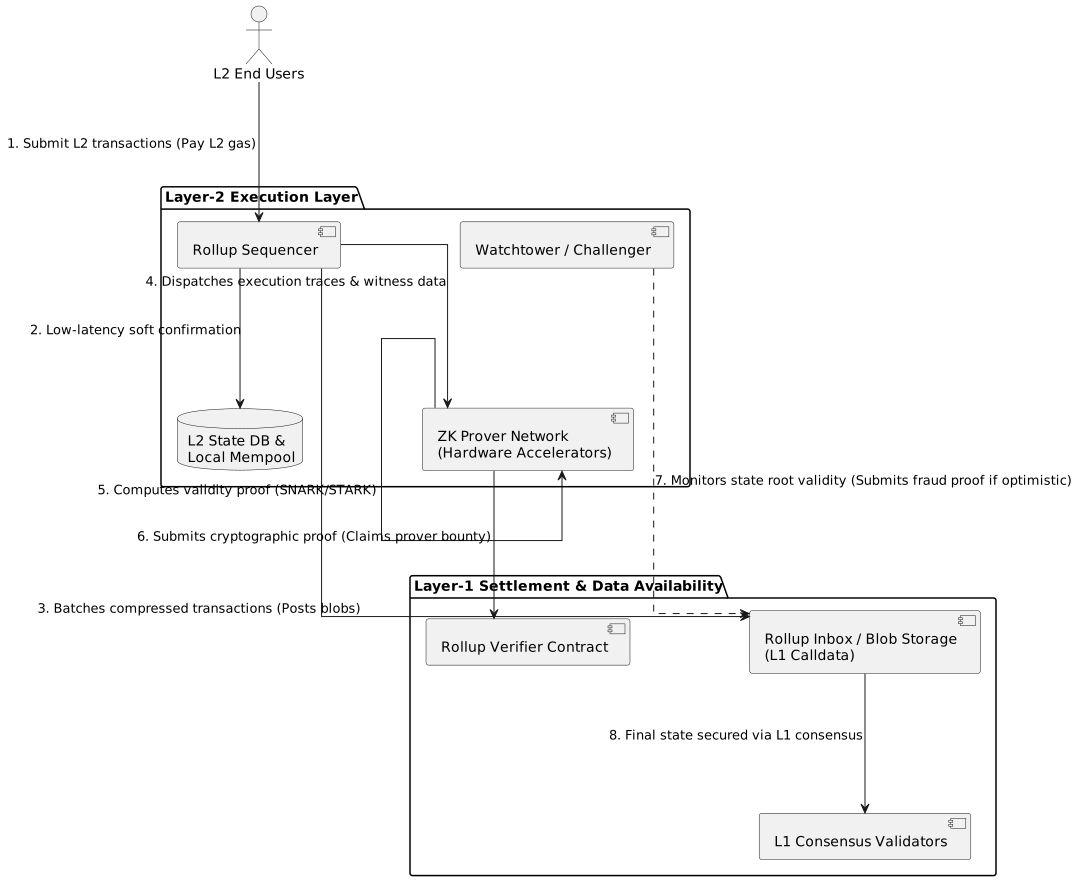
The architecture below captures the execution lifecycle across Layer 2 and Layer 1. It details how user transactions move through Sequencer mempools, trigger asynchronous zero-knowledge proof generation, utilize EIP-4844 blobs for cheap calldata posting, and settle through L1 verifier contracts:
Core Components & Economic Models
The rollup architecture partitions responsibilities across off-chain execution layers and on-chain security contracts:
Rollup Sequencer
Ingests, orders, and executes transactions off-chain, granting users instantaneous sub-second confirmations.
Revenue: L2 User Gas minus L1 Data Posting CostsZK Prover Network
Specialized hardware clusters (GPU/FPGA/ASIC) generating cryptographic validity proofs (SNARKs/STARKs) certifying state changes.
Revenue: Protocol Bounties per Verified ProofWatchtowers & Challengers
Independent monitoring nodes that audit optimistic rollup state publications, triggering fraud-proof dispute games if invalid state transitions occur.
Revenue: Malicious Actor Slashing BountiesBlob Storage (EIP-4844)
Ephemeral, low-cost L1 storage blobs that carry transaction data off-chain for 18 days, dramatically reducing calldata expenses.
Model: Dedicated Dynamic Blob Gas MarketL1 Verifier Contract
Smart contract on Ethereum L1 that verifies ZK validity proofs or adjudicates fraud disputes, finalizing L2 state roots trustlessly.
Function: Pure Cryptographic SettlementL1 Consensus Validators
The base-layer validator set providing immutable consensus and finality for both L1 transactions and L2 posted blob headers.
Revenue: L1 Base Fee + Blob Base FeeSequence Flow Analysis
Walking through the twelve key stages documented in Figure 2.1 highlights how high throughput is achieved without compromising trust:
L2 Transaction Submission
End users sign and transmit transactions to the Rollup Sequencer endpoint, paying nominal L2 gas fees.
Soft Confirmation
The Sequencer issues an immediate, low-latency receipt ("soft confirmation") to the user, providing snappy Web2-level application responsiveness.
Local Ordering & Execution
The Sequencer checks nonce sequences and account balances, orders transactions, and calculates the resulting off-chain state transition.
State DB Update
The updated account balances and contract storage slots are recorded into the rollup's local state database.
Asynchronous Validity Proving
For ZK-Rollups, the Sequencer dispatches the execution trace to a decentralized network of hardware-accelerated ZK Provers. Provers solve cryptographic circuits to synthesize a succinct mathematical proof (SNARK or STARK).
Data Availability Posting (EIP-4844)
The Sequencer compresses hundreds or thousands of transactions into binary payloads and posts them as ephemeral "blobs" to the L1 consensus layer, ensuring anyone can reconstruct the rollup state.
Challenger Audit Window
For Optimistic Rollups, Watchtowers audit the posted state root against available calldata. If fraud is detected, an interactive bisection challenge is submitted to penalize the rogue sequencer.
Smart Contract Proof Verification
For ZK-Rollups, the validity proof is sent to the L1 Rollup Verifier Contract. In milliseconds, the contract checks elliptic curve pairings to verify that millions of dollars in transfers executed correctly.
L1 Finality
Layer-1 validators finalize the block containing the updated state root and blob reference, completing final, irreversible settlement.
Commercial Dynamics: Sequencer Economics
The profitability of a rollup operator is governed by a straightforward equation:
Sequencer Profit = (L2 User Gas Collected) - (Cost of L1 Blob Gas + ZK Prover Compute Fees)
Prior to the deployment of Ethereum's Dencun upgrade (EIP-4844), L1 calldata accounted for over 90% of a rollup's total operating expenses. The introduction of dedicated blob space decreased posting costs by 95%+, allowing rollups to pass transaction costs under $0.01 directly to end users while preserving economic sustainability.