
In the early days of decentralized networks, transaction processing followed a simplistic mental model: a user signed a transaction, broadcast it to the peer-to-peer network's public mempool, and a solo miner picked the highest fee transactions to bundle into the next block.
Today, on high-throughput smart contract networks such as Ethereum, that monolithic model has been completely unbundled into a highly specialized, multi-actor pipeline known as the Transaction Supply Chain. Driven by the economics of Maximal Extractable Value (MEV) and formalized through Proposer-Builder Separation (PBS), this architecture separates transaction creation, ordering optimization, payload relaying, and block proposing into distinct market roles.
System Architecture Diagram
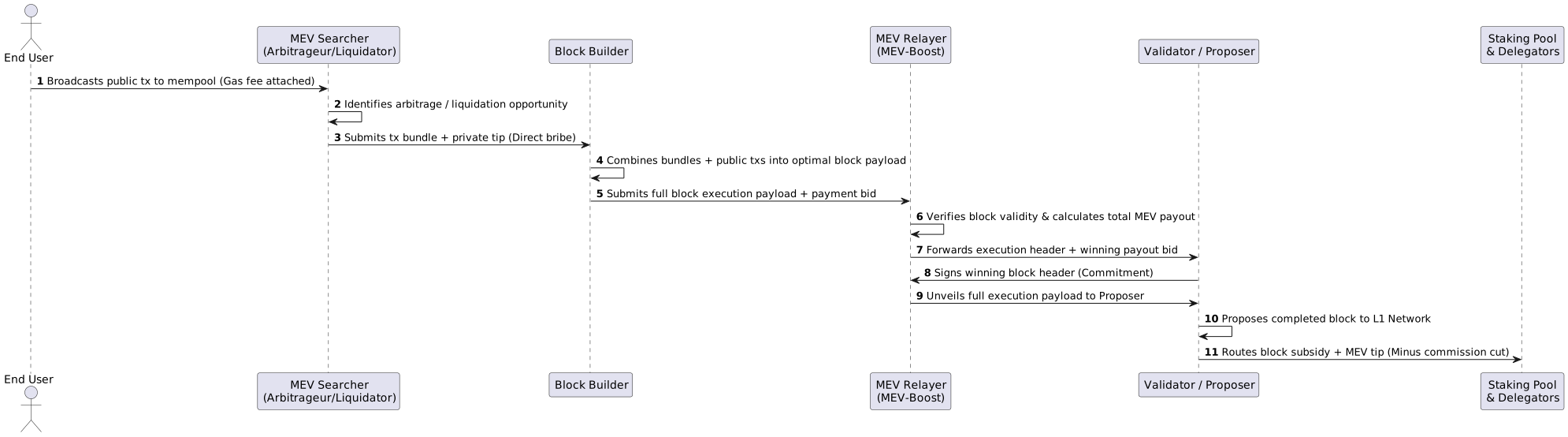
The sequence diagram below models the complete lifecycle of a transaction through the modern MEV-Boost pipeline, tracking the interactions between the end user, MEV searchers, block builders, relayers, validators, and staking pools:
Key Participants & Commercial Incentives
Each participant in the pipeline performs a distinct computational and financial function, operating with specific economic incentives:
1. End User
Submits transactions from web3 wallets (swaps, transfers, mints) with an attached gas fee to compensate the network for state execution.
Pays: Base Fee + Priority Tip2. MEV Searcher
Automated algorithmic bot operator scanning mempools to capture atomic arbitrage, DEX liquidations, and sandwiching opportunities.
Revenue: Arbitrage/Liquidation Spread3. Block Builder
High-performance node aggregating private searcher bundles with standard public transactions to construct the most profitable block payload possible.
Revenue: Bundle Fee Spreads4. MEV Relayer
Trust-minimized, low-latency broker that validates block headers and execution payloads between builders and proposers via MEV-Boost.
Revenue: Protocol Subsidy / Micro-fees5. Validator / Proposer
Consensus node assigned by the protocol to propose the next block to the L1 network, selecting the highest bid without inspecting transaction contents.
Revenue: Block Subsidy + MEV Tips6. Staking Pool & Delegators
Liquid staking protocols (e.g., Lido, Rocket Pool) and pooled delegators receiving smoothed block rewards minus operator management cuts.
Revenue: Aggregated Staking YieldStep-by-Step Sequence Breakdown
Walking through the numbered interaction flow documented in Figure 1.1 reveals how trust and incentives are maintained:
Mempool Broadcast
The End User submits a signed transaction to the public peer-to-peer mempool, paying a gas fee determined by EIP-1559 (base fee plus priority tip).
Opportunity Identification
MEV Searchers parse the pending transaction stream in real-time, detecting price discrepancies across liquidity pools or undercollateralized lending positions.
Bundle Construction & Private Bribe
The searcher packages their own transaction together with the target transaction into an atomic "bundle" and submits it directly to a Block Builder with a private tip, avoiding the public mempool.
Optimal Block Assembly
The Block Builder simulates multiple bundles simultaneously to prevent execution collisions, combining non-conflicting bundles with regular transactions to maximize total block revenue.
Payload Submission to Relayer
The Builder submits the complete execution payload alongside an explicit payment bid to an MEV Relayer.
Validation & Bid Verification
The MEV Relayer verifies that the proposed block is consensus-valid and that the builder's payment promise to the validator is accurate.
Header Auction
The Relayer presents the winning block header and associated payout value to the current slot's assigned Validator/Proposer.
Blind Commitment Signature
The Validator commits to proposing the block by signing the header sight-unseen, legally binding them to the builder's payload.
Payload Unveiling
Upon receiving the validator's signature, the Relayer releases the full execution payload to the Validator.
Network Block Proposal
The Validator broadcasts the finalized block across the Layer-1 peer-to-peer network for attestation and consensus finalization.
Subsidy & Tip Routing
The protocol rewards (block subsidy) and MEV tips are routed to the staking pool smart contract, distributing yields to underlying token delegators after deducting protocol commission fees.
Why Proposer-Builder Separation Matters
Prior to PBS, individual validators had to run proprietary searcher algorithms themselves to extract MEV. This created extreme centralization pressures: large staking operations with sophisticated algorithmic infrastructure earned vastly higher yields than solo stakers, threatening the censorship resistance of the base layer.
By creating a competitive, open marketplace for block building, MEV-Boost ensures that even the smallest solo validator receives access to the highest-yielding block on the market, democratizing rewards and preserving base-layer neutrality.